I’m starting to feel a little gaslighted1 about what a gerontologist does.

I mean, I think I know what a gerontologist does. I am a gerontologist. But maybe I don’t know? Maybe I’m wrong? (Classic gaslighting.)
I ask myself, do I know what gerontology is? So I go to the source, my professional society, The Gerontological Society of America. This is the definition I see:
“Gerontology is the study of aging processes and individuals across the life course.”
Yup, that is what I thought too.
“It includes:
- The study of physical, mental, and social changes in people as they age;
- The application of this knowledge to policies and programs.”
- The investigation of changes in society resulting from our aging population; and
Sounds right to me.
“Gerontology is multidisciplinary in that it combines or integrates several separate areas of study……”
Yup, that tracks.
“Geriatrics, the branch of medical science concerned with the prevention and treatment of diseases in older people, is a part of the broader field of gerontology.”
Hmmm.
This last sentence confuses me. I knew that medical aspects of aging are a part of the aging experience, but I didn’t think that the field of geriatrics was a part of gerontology.
I thought geriatrics was a separate field from gerontology, because it is a branch of medicine, and gerontology is distinct from the field of medicine.
If geriatrics is a part of gerontology, can geriatricians call themselves gerontologists? If geriatricians are gerontologists, is gerontology a part of the field of medicine?
This seems very confusing.

Maybe it is just me that is confused. What do other people think?
One way to see what a gerontologist is, is to do a search for gerontology jobs.
Here is what happened when I did a search for “gerontology jobs” in google. I saw a lot of jobs for physicians and nurse practitioners. Interestingly, when I did a search for “gerontologist” jobs, there were no physician jobs, but most jobs that popped up were clinical, as in “clinical gerontologist”. Interesting, because most of the gerontologists I know are not clinical. In fact, almost none of them are. Now, I do know some gerontological nurse practitioners, but they don’t refer to themselves as gerontologists.
Interestingly, when I searched for “gerontologist” in the AgeWork career site, which is a part of the Gerontological Society of America, there were also a sizable number of physician positions listed. Again, interesting and confusing.
In my experience, most gerontologists would not be qualified for any of these jobs, as they require clinical training and/or medical degrees. And gerontology degrees do not typically include either. Confusing, But maybe I don’t know what a gerontologist is?

Another way to get clarity on what a gerontologist does, is for me to pay attention to what people say when I introduce myself as a gerontologist out there in the world.
Almost all of the time I am mistaken as a geriatrician.
Here is a partial list of recent experiences when I told people I was a gerontologist and they thought that meant I was a geriatrician:
- A local aging network meeting where professionals in aging asked where I practice and see patients
- An event on the topic of dementia, that was offered by individuals in the art community, but whose audience were members of the public who assumed I was a doctor
- A conversation with a national advocate in aging and caregiving
- A conversation with an individual who heads up a program for people living with dementia
- A presentation I gave to a group of older adults about the stigma of dementia
- In interviews I had with people living with dementia
- A conversation with an administrator at a senior living community
- My neighbor, who is an older adult and navigating several health issues
- Another neighbor who works in healthcare
- My mammogram technician
- My oral surgeon
- The creative reuse center where I volunteer
- A dean at a university that has a gerontology program
So maybe I REALLY don’t know what a gerontologist is.

What I do know is that I am hearing messages from multiple sources that there is GREAT confusion in what a gerontologist does, and for the most part, it is generally confused with being a geriatrician.
Yet, I feel like I am being gaslighted. Do I really not know what a gerontologist is? If I am to look at job positions, it does not seem like I do. If I am to speak to the general public, it does not seem like I do.
Am I wrong? Maybe I have gotten it wrong all along.
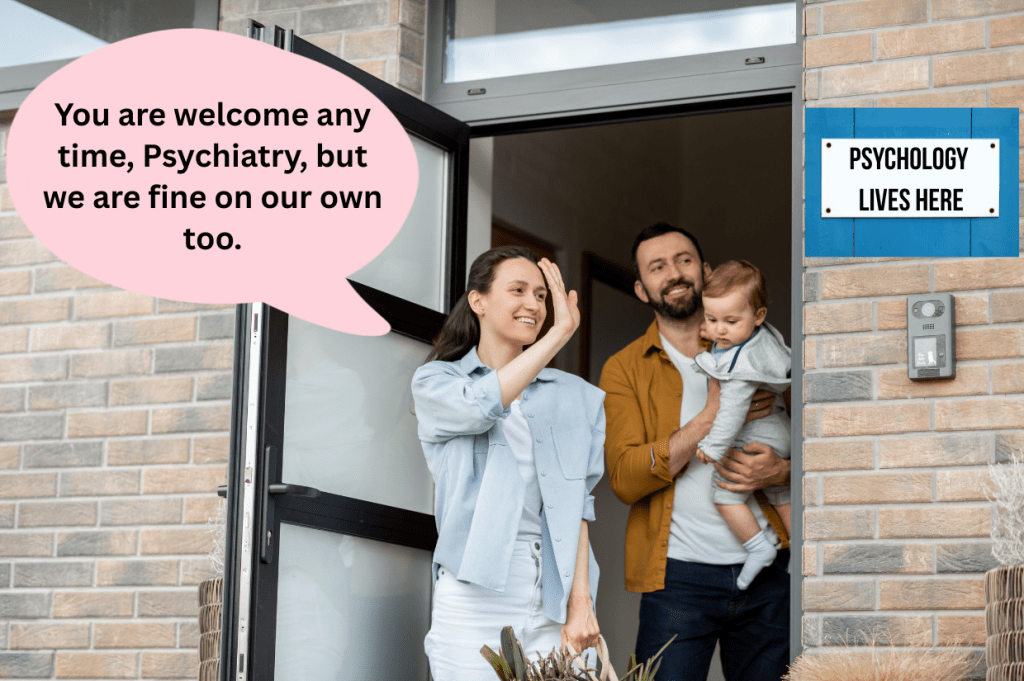
Sometimes when I get confused about things, I try to look at other examples in parallel universes to test out ideas. So, a similar example might be found in the field of psychology vs the branch of medicine called psychiatrics. They are similar in that both relate to mental health and the study of the mind, brain, and behavior, just like gerontology and geriatrics both relate to aging.
But there are also clear differences, especially when you are talking to a psychologist vs a psychiatrist. I don’t think psychiatrists would consider themselves psychologists, or vice versa. I also don’t think psychology would consider itself the umbrella term that encompasses psychiatry. It seems like they are comfortable being their own thing.
To the general public, there might be some confusion – I definitely have heard people use the terms psychologist and psychiatrist interchangeably, and not really know the difference.
It is a little different than gerontology, in that it seems clearer what a psychologist is. There is still confusion, but, as a field of study, they seem to be pretty confident about who they are.
I do not feel this way in gerontology. Maybe we gerontologists know who we are, but then we receive very confusing messages from out there about who we are. Which makes us feel like we are being told another story about who we are. Which makes us question who we are.
This feels to me like gaslighting – “they” are making us question who we are. By sowing confusion about what gerontology is and what gerontologists do. I am not sure who “they” are. Maybe “they” are not a group of people but a paradigm of aging. I don’t know. But I think the gaslighting is somewhat successful in that we, as a field, seem confused, and as a result, we are presenting a confused appearance to the public.

This seems unfair to perpetuate a confused image of gerontology to the public. At the very least, they don’t know what we are capable of and how we might be useful.
A lack of clarity in what gerontology is and isn’t is also a missed opportunity – to promote the reality that aging is more than medical, that it does not need to be regularly associated with medicine.
Even more, it is a missed opportunity to define gerontology as a multidimensional approach to aging that includes all aspects of living and being human.
What an opportunity there is to distinguish the experience of growing older and its complexity as distinct from medical or clinical. Every time I talk to a person and they think I am a geriatrician, I am reminded of this deeply held paradigm in the general public that aging is mostly about medical stuff. It is almost as if they are not sure what else there could be?
I should note that gaslighting is a result of power imbalances. Medicine has more power than gerontology. I think that is a truth. I am not saying that medicine is the gaslighter. I am saying that the possible perception that medicine is more important than other aspects of aging could be a source of where the gaslighting comes from. And I am also not ignoring the reality that geriatrics itself is considered less important than other branches of medicine, under resourced, and has their own stigmatization issues. That is why we need each other! But maybe we also need to claim our own identities.
There are questions still. How do we integrate the overlapping fields of study that are a part of gerontology but maybe not actually gerontology? What distinguishes gerontology? Most importantly, what do these differences mean to the people we ultimately serve, older adults themselves?
Gerontology, we need to confront the gaslighting. We need to take back the power and address our confusion. It is uncomfortable, but so is not knowing who we are.

 Being Heard